

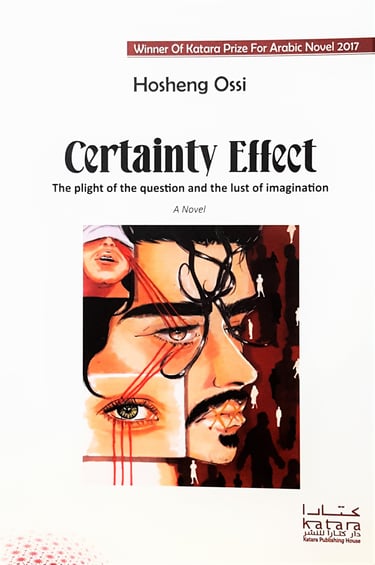
The novel The Burden of Certainty: The Ordeal of Questioning and the Desire of Imagination was published by "Soual" in Beirut at the end of 2016. It consists of 380 medium-sized pages. The author dedicated his first novel to the Belgian city of Ostend, where he resides.
The novel won the Katara Prize for Arabic Fiction in Qatar in 2017, the most prestigious literary award for novels in the Arab world. It was also translated into English and French by the Katara Foundation in 2018.
The narrative revolves around the Syrian revolution from its outbreak until 2013, approached in a distinctive, indirect manner that avoids immersion in daily events and details. The novel has no single central protagonist; rather, each character may be regarded as a central figure in their own right. Its events unfold across a wide and diverse geographical landscape, including Belgium, Morocco, Switzerland, the United States, Tunisia, Libya, Egypt, Israel, Syria, Lebanon, Turkey, Kurdistan, and Iraq, ultimately returning to Belgium.
The novel raises profound questions about life and death, love and hatred, as well as the nature of revolutions, dreams, disappointments, and fractures. These themes are explored through the experiences and life stories of individuals both inside and outside the Syrian reality, with all its intertwined complexities. The work aims to shed light on the international and regional involvement in the Syrian tragedy, while also highlighting the presence of foreign humanitarian engagement with the Syrian revolution and its suffering.
A variety of narrative techniques are employed throughout the novel, including epistolary writing, short stories, poetry, theatre, political analysis, intellectual and everyday dialogue, and monologue. The temporal rhythm of the narrative is nonlinear and ambiguous, with spatial settings taking precedence over chronological order.
The text engages critically with historical narratives by introducing imagined events intended to challenge and undermine the official versions of history.
The novel also includes depictions of political assassinations and love stories that end in death. These relationships often arise between individuals of different nationalities or religions, such as: Catherine, a Belgian woman, and Kamal, a Tunisian man; Giorgio, an Italian, and Ils, a Belgian woman; a Muslim young man and a Christian woman; a Muslim jinni and a Christian youth; a Kurdish female fighter and a Turkish soldier, among others.
The author makes use of reincarnation and spiritual transference, alongside Sufi and philosophical dimensions woven into the narrative, and employs poetic language throughout the prose.
At the heart of the novel is the story of a Syrian opposition activist—an Alawite leftist from a religious family—who spent fifteen years in prison. After his release, he turned to writing. He fell into deep despair and frustration following the failure of internal reform and the corruption and normalization of authoritarianism within Syrian society. The Tunisian revolution rekindled his sense of hope and vitality, and he embraced these uprisings as a rebirth for himself, as well as for peoples, homelands, and societies. His hope grew further with the outbreak of the Syrian revolution.
He was arrested on “Friday of Azadi” (May 20, 2011), as peaceful demonstrations were traditionally held on Fridays, each bearing a specific name. He died under torture and was killed by a security officer who came from his own village and had been his classmate in elementary school. His organs were removed and trafficked through international organ-smuggling networks to Europe.
These organs arrived in Belgium and were transplanted into the bodies of three individuals living there: a Congolese man, a German woman working at ING Bank, and an Italian student at the Free University of Brussels. The transplanted organs bring about profound changes in the chemistry of the recipients—their interests, moods, and talents—drawing them toward culture, literature, and art, and toward closely following and supporting the Syrian revolution. They begin to experience dreams as though they had once lived in Syria.
A group of revolution sympathizers forms, including these three individuals. One of them proposes the hypothesis that the changes in their personalities and inclinations stem from the transplanted organs, especially since all three surgeries were performed at the same hospital. A journey begins to trace the DNA of each organ, revealing a perfect match and confirming that all the organs belonged to a single individual.
The group agrees on the necessity of identifying the person whose spirit now partially inhabits the bodies of the three recipients. Since an organ is removed while still alive, it is believed to retain a fragment of its owner’s soul—one that transfers to the recipient and leaves its mark.
Within a crime-fiction framework and after an arduous search, the identity of the organ donor is revealed. He is found to have a brother, a defected military officer living in refugee camps in Turkey, and a close friend and former fellow detainee and political companion—a Syrian Armenian writer living in Sweden. Contact is made with the defected officer, and his DNA is examined and compared with that of the transplanted organs, conclusively proving that they all belonged to one person: the brother of the defected officer.
Further aspects of the opposition activist’s life emerge through the testimonies of his brother and his Armenian friend. Prior to his death, he had left four typed letters with the Armenian friend, along with incomplete shared papers that were intended as a joint literary project between them. These letters are presented sequentially as narrative stations within the novel, without revealing the author’s name.
After completing the long process of uncovering the identity and life of the organ donor, the group agrees to compile all the documents and recount the search for his life and identity in a book. While escorting the Armenian friend to Brussels Airport, the three organ recipients and their companion are all killed in a car accident when a large truck collides with their vehicle.
The novel concludes with an open ending, leaving unanswered questions: Who will complete the book project? And who will tell this story? The narrative deliberately refrains from clarifying whether the accident was accidental or deliberately orchestrated.
The Burden of Certainty: The Ordeal of Questioning and the Desire of Imagination