

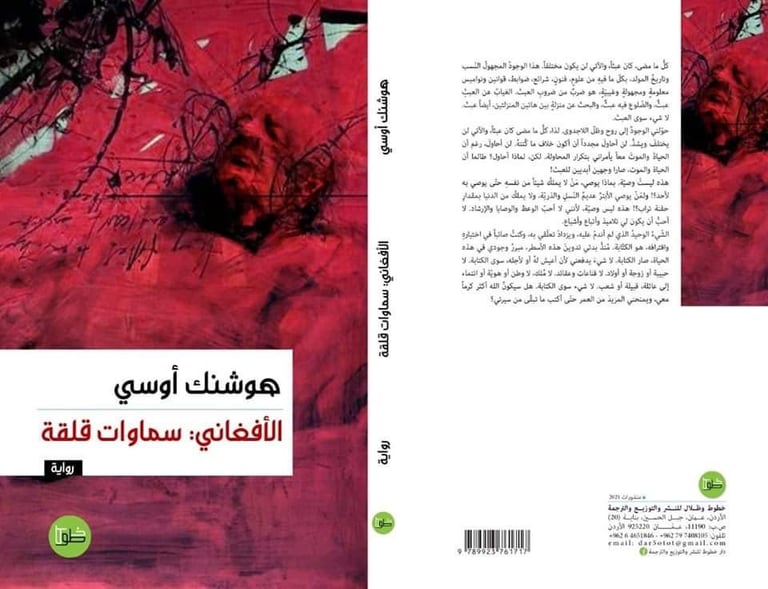
The Afghanian: Restless Skies
The Greek authorities contact the Afghan embassy to the European Union in Brussels to receive the body of its alleged citizen. The embassy responds that it is impossible to verify the man’s identity, as the civil records in his hometown were destroyed by war, and that he may have falsely claimed Afghan nationality.
The investigation enters its first phase: determining whether the victim was truly Afghan. Among the migrants interrogated, seven individuals had close connections with the deceased:
1. An Egyptian migrant, who denies that the victim was Afghan and insists he was Egyptian, recounting his story with dates and details suggesting that he was among the Egyptians who travelled to Afghanistan to fight (the “Arab Afghans”) and later returned to Egypt.
2. A Palestinian migrant, who rejects both the Afghan and Egyptian identities, asserting that the victim was Palestinian, supporting his account with places, dates, and elements tied to the Palestinian narrative.
3. An Afghan migrant, who confirms that the victim was Afghan, offering a different story backed by facts and dates, and hands the investigator a poem written by the deceased in Afghan Pashto.
4. An Algerian migrant, who denies the Afghan identity and claims the victim was Algerian, narrating in detail what he knows about him.
5. A Tunisian migrant, who dismisses all other identities and insists the victim was Tunisian, recounting a story rooted in the Tunisian social and political context.
6. An Iranian migrant, who denies that the victim was Afghan and asserts that he was Iranian, presenting yet another biography rich in dates and information linked to Iranian reality.
7. A Kurdish migrant from Syria, who also rejects the Afghan identity, claiming the victim was a Kurd from Iraq, and narrates a story unlike all the others, dense with events, dates, and names connected to Kurdish life in Iraq and Türkiye.
The investigation is closed, and the man is buried without his identity ever being established.
A decade later, in 2019, a box containing a bundle of papers written in Pashto is discovered. After examination and translation, it becomes clear that the texts belong to the murdered man and reveal his true identity and life story: a being to whom God granted what was not granted even to prophets and messengers—an extraordinarily long life without offspring. He is neither prophet nor messenger. He was born on the day Caliph Umar ibn al-Khattab was assassinated and witnessed pivotal events in Islamic history, from the Battle of Siffin to the Battle of Nahrawan. His father was among the prominent figures of the group that broke away from Ali ibn Abi Talib. Thus, he is a being that transcends eras and centuries, whose continued existence depends on safeguarding his secret. In the end, he turns to writing as a way to circumvent the condition of absolute secrecy.
In his writings, “the Afghan” presents an alternative narrative of the Battle of Nahrawan, as well as different interpretations of historical events as recorded in official history books—challenging them through a logic that exposes the authority behind their construction.
The Afghan: Restless Skies engages with numerous themes, including identity and belonging, immortality, falsified history passed down as truth, love, life, and death. The novel presents eight narratives revolving around the life of a single person, deliberately exceeding the symbolic number seven—for seven days of the week, seven heavens, seven earths, seven seas, and the popular belief that one who survives disasters possesses seven lives.
Although the novel revolves around a murder and an investigation, it is not a crime novel in the conventional sense. Nor is it a historical novel, as it fundamentally questions and unsettles the inherited official version of history.
The novel was first published by Khutut wa Zilal Publishing House in Jordan in 2021, and its second edition was released by Al-Zaman Publishing House in Syria in 2025.
Its events unfold in a detention center for undocumented migrants on the Greek island of Chios during the summer and autumn of 2009. One of the detainees disappears under mysterious circumstances, prompting prison authorities to open an investigation. A week later, his body is discovered brutally murdered in the courtyard of a church near the prison. The victim had introduced himself to the Greek authorities as an Afghan refugee. The investigation thus shifts from searching for a missing person to uncovering his true identity, as a gateway to understanding the circumstances of his murder and the motives, causes, and hidden backgrounds behind it.