

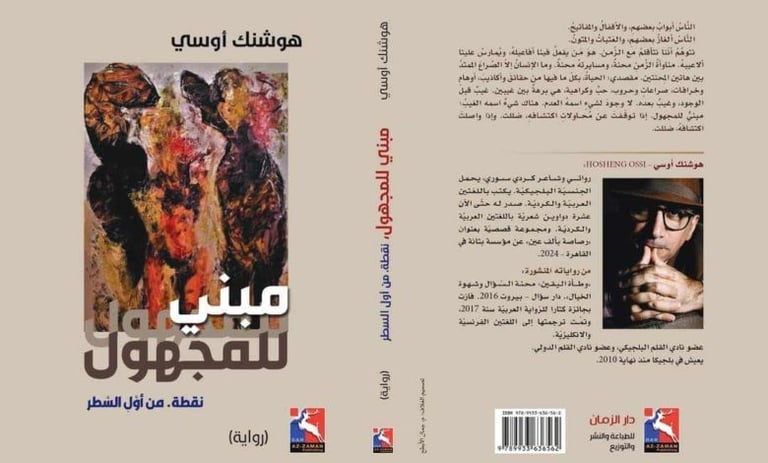
The novel is set in a retirement home in the Belgian city of Ostend (Oostende), unfolding through the recollections of several residents who recount fragments of their memories. The narrative spans multiple places, cultures, and characters, while its timelines intertwine from the period preceding the First World War up to the year 2019.
Passive Voice: A Full Stop at the Beginning of the Line
Among the locations featured in the novel are Belgium, Iraq, Vietnam, Turkey, Kurdistan, the Congo, Algeria, Lebanon, and Syria. In this novel, Hosheng Ossi seeks to embed his imagined fictional characters within real historical events that took place in these countries, lending them a layer of speculative, virtual fictionalization. By way of example, a Belgian journalist conducts an imagined interview with the Iraqi leader Abd al-Karim Qasim and the Kurdish leader Mullah Mustafa Barzani.
The novel also employs multiple narrative voices, all framed within the perspective of an omniscient narrator who governs the movement of the narratives within the overarching structure of the work. The result is a complex narrative architecture, akin to a labyrinth. A Belgian writer, Jan de Schipper, appears at a book fair to present his new novel, whose protagonist is a young journalist aspiring to write a novel of his own. He conducts interviews with the residents of the retirement home, placing the reader before three novels by three different authors: Hosheng Ossi, who presents Built in the Passive Voice; within it, Jan de Schipper’s novel The Unwanted; and within that, in turn, the novel written by the young Belgian journalist Tom Van Linden.
Built in the Passive Voice is a work rich in intellectual, cognitive, social, and political content. It advances critical perspectives on history and on the reality lived by human beings, regardless of gender, religion, or nationality. The story of each fictional character nearly constitutes an independent short novel (novella) within Built in the Passive Voice.
The novel ultimately affirms love, opposes wars rooted in ethnic and religious divisions, and calls for religious reform and tolerance.